Branding vs Marketing: Differences, similarities and what you really need

Branding and marketing are related, but they do different jobs. Branding decides who a company is, what it promises and how it looks and sounds. Marketing finds the people who need what the company sells and persuades them to act. Branding works over years and builds recognition and trust; marketing works in campaigns and short test cycles and is judged by leads and sales. Most companies need both, and the brand usually comes first, because marketing pays to put it in front of people.
Below we define each one, compare them side by side, separate both from advertising, show examples from our own projects and go through four common situations to show which one to work on first.
What is branding?
Branding is the set of decisions that make a company recognisable: what it promises, who it is for, and the name, look and voice that carry that promise. The brand is the result: what people recall about the company when they see its name, its logo or its product.
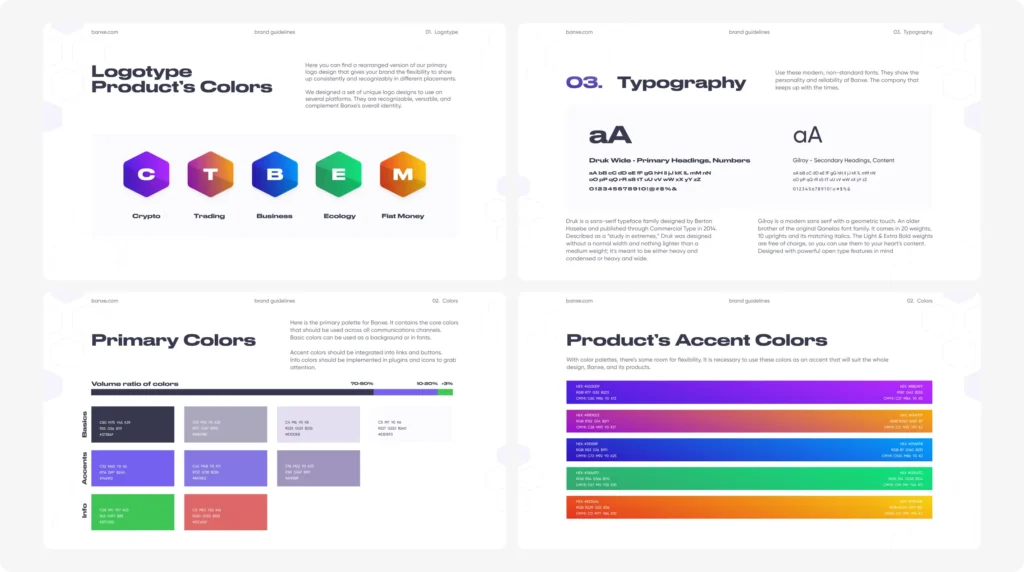
Its job is practical. A clear brand lets people tell a company apart from its competitors and gives them a reason to choose it that is not the price. On our projects these decisions end up in brand guidelines, like the ones we wrote for Banxe.
What a brand is made of
- Visual identity. The logo, colours, typefaces, icons and imagery, plus the rules for putting them together, so a slide, a screen and a post look like they come from one company.
- Voice. How the company writes: the words it uses and avoids, how formal it sounds, and the few messages it repeats everywhere.
- Promise and values. What the company commits to and what it will not do. Without them the logo and the voice have nothing true to say.
These parts are usually written down in brand guidelines, sometimes called a brandbook, so designers, writers and outside partners apply them the same way.
How long a brand lasts
Branding is relatively stable. A well-built identity can last for many years and evolves gradually as the market and customer preferences change. Large changes, such as a new name or a new logo, happen rarely and are called a rebrand.
What is marketing?
Marketing is the work of finding the people who need what you sell, reaching them and persuading them to take an action: visit a site, sign up, request a demo, buy or invest. Where branding defines the company, marketing creates demand for it and turns attention into customers.
The purpose of marketing is growth you can measure. A marketing team decides who to target, which offer to show them, where to show it and how much to spend, then checks what worked and moves the budget to it.
The main parts of marketing
- Research and positioning. Who the customers are, what problem they are trying to solve, which alternatives they compare you with, and how your offer should be framed against those alternatives.
- Channels. The places where you reach people: search, paid ads, social media, email, partnerships, events, sales outreach. Most companies do better with the two or three where their buyers already are.
- Campaigns. Time-limited pushes built around one goal, such as a product launch, a new feature, a seasonal offer or a funding announcement.
- Content. Articles, social posts, videos, case studies, newsletters and landing pages that answer customers’ questions and give the channels something to carry.
- Measurement. Tracking traffic, sign-ups, conversion rates, cost per customer and revenue, so the team knows which channels and messages pay off.
How marketing works over time
Marketing runs on a much shorter clock than branding. Campaigns last weeks or months, ad creatives are replaced regularly, and good teams test all the time: two headlines or two landing pages, one variable at a time. Plans are reviewed monthly or quarterly, and a channel that stops paying off is cut.
Branding vs marketing: the key differences
In short, branding shapes what people think of a company, and marketing decides how they hear about it and what makes them act. The table compares the two point by point.
| Branding | Marketing | |
|---|---|---|
| Main goal | Define who the company is and make it recognisable and trusted | Reach the right people and get them to act |
| Question it answers | Who are we, what do we promise, and why should anyone care? | Who should hear about us, where, with what offer, and what will make them act? |
| Time horizon | Years; changes slowly and on purpose | Weeks and months; campaigns, short cycles, constant testing |
| What it produces | Positioning, name, logo, visual identity, voice, brand guidelines | Campaigns, ads, content, emails, landing pages, sales materials |
| How success is measured | Recognition and recall, consistency across touchpoints, how customers describe the company, direct and branded search traffic | Leads, conversion rate, cost per customer, return on ad spend, revenue |
| Who owns it | Founders and leadership, usually with a brand or design team or an outside studio | A marketing or growth team, often with channel specialists or agencies |
Another way to see it: branding is mostly a set of decisions made once and then kept, while marketing is a set of experiments run again and again.
Is branding part of marketing?
It depends on whom you ask. In many companies the brand team sits inside the marketing department, so branding is treated as one of marketing’s tools. In practice the two work better as separate disciplines with different jobs: branding is the decision about who the company is, made rarely and then kept; marketing is the everyday work of bringing that company to buyers.
They overlap in brand marketing: campaigns that build awareness of the company and what it stands for, rather than asking for a sale right now. Its opposite is performance marketing, which is judged on clicks, sign-ups and purchases over a short horizon.
Branding, marketing and advertising: what is the difference?
Advertising is one part of marketing: the paid placements, such as search ads, social media ads, banners and sponsorships. Marketing is wider: it also includes research, positioning against competitors, content, email, partnerships, events and measuring what works. Branding sits under all of it and decides what every campaign and every ad looks like, sounds like and promises.
Marketing
Research, positioning, channels, content, email, partnerships, events, measurement
Advertising
Paid placements: search and social ads, banners, sponsorships
Branding
The base under every campaign and ad: positioning, name, visual identity, voice
That is why a company can pause its ads for a quarter and keep marketing itself through content and partnerships, and why it can change agencies, channels and campaigns many times while its brand stays the same.
How are branding and marketing similar?
For all the differences, the two have a lot in common.
- They speak to the same people. Both start from an understanding of the audience: who they are, what they need and what makes them trust a company.
- They both shape perception. The brand sets the impression, and every ad, post and email either confirms it or wears it down.
- They use the same materials. The logo, colours, typefaces and voice defined by branding appear in every marketing piece.
- They serve the same business goal. More of the right customers, who choose the company more often and stay longer.
How do branding and marketing depend on each other?
Marketing without a brand can bring sales, but each campaign starts from zero. Ads look different from the website, the website looks different from the deck, and nothing adds up to recognition. When people cannot tell you apart from competitors, price is the only argument left.
A brand without marketing has the opposite problem. The identity may be well thought out, but too few people see it for it to matter.
The dependency runs both ways. The brand gives marketing its material: the positioning to build offers on, the voice to write in and the visual system to design with. Marketing gives the brand feedback: research and campaign results show which messages customers respond to and which claims they ignore. Over time that evidence flows back into the brand’s messaging, which is one reason brands evolve gradually instead of standing still.
Brand
Positioning, voice, visual system
gives marketing its material
returns evidence: which messages customers respond to
Marketing
Channels, campaigns, results
Branding vs marketing: examples from our projects
The difference is easiest to see on one company. In each example below the brand is the part that stays fixed, and the marketing materials are the part that changes from campaign to campaign.
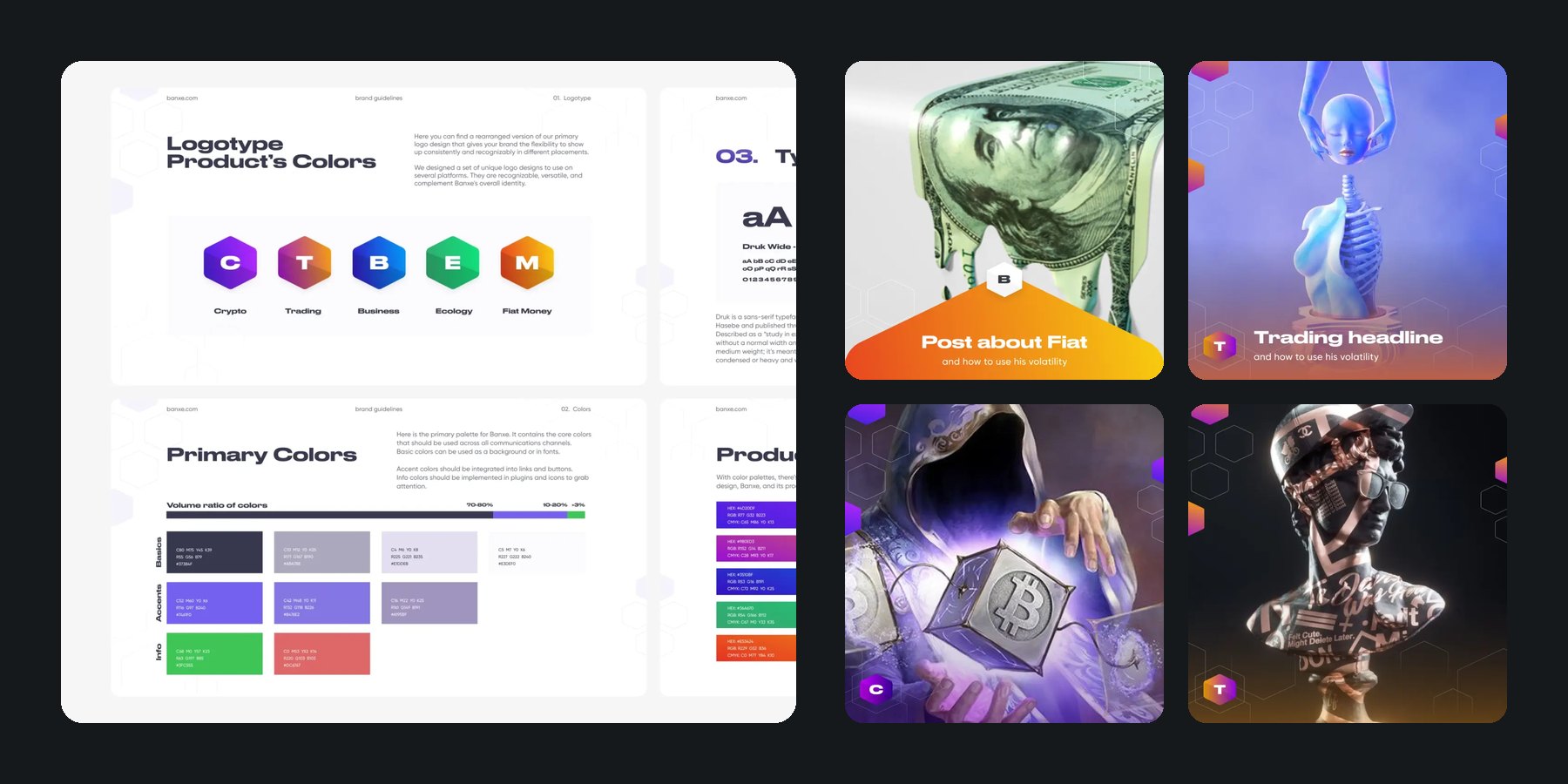
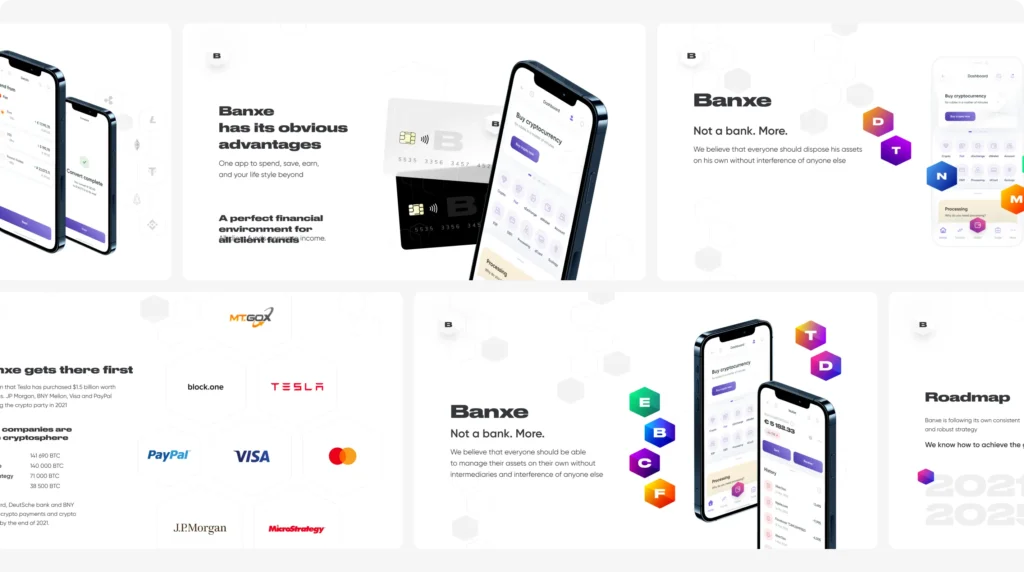
For Banxe, a financial platform that joins fiat and crypto services, we designed the brand identity and wrote its rules down in brand guidelines. The system is built on hexagons, one per product, each with a gradient of its own; two typefaces split the work between headings and body text; and the guidelines fix how much of a layout each colour may take. The same rules run through the exchange screens, the wallet app, the social media post templates and the pitch deck.
The marketing side shows in the social media templates we built for Banxe. Each post frames a full-bleed picture, such as a classical bust, a hooded figure holding a Bitcoin cube or a melting dollar bill, with hexagon outlines along the edges and a lettered badge in one corner. The picture and the headline change with every post; the badge, the hexagons and the type come from the brand, so a new picture drops in without breaking the layout and the post still reads as Banxe.


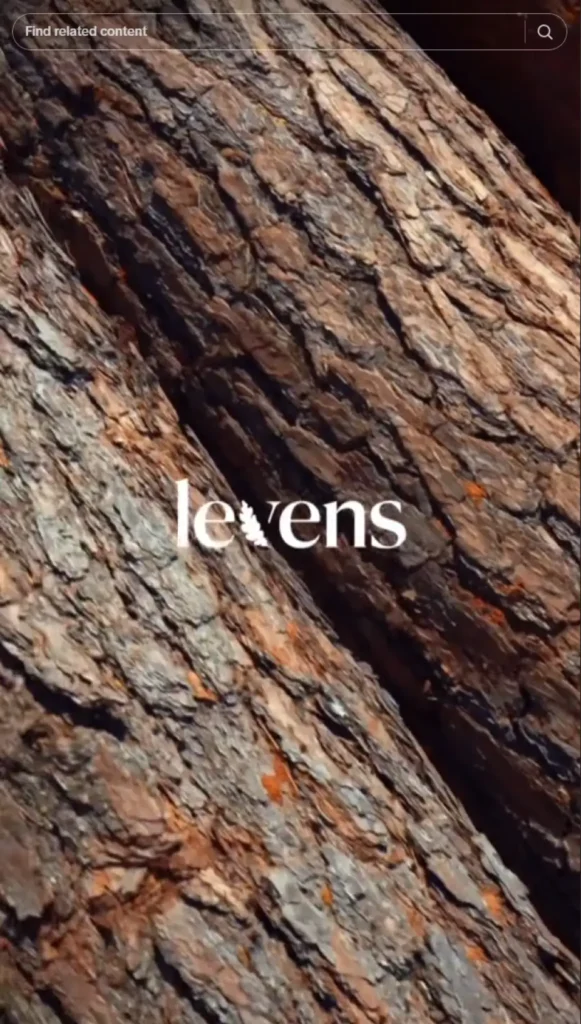
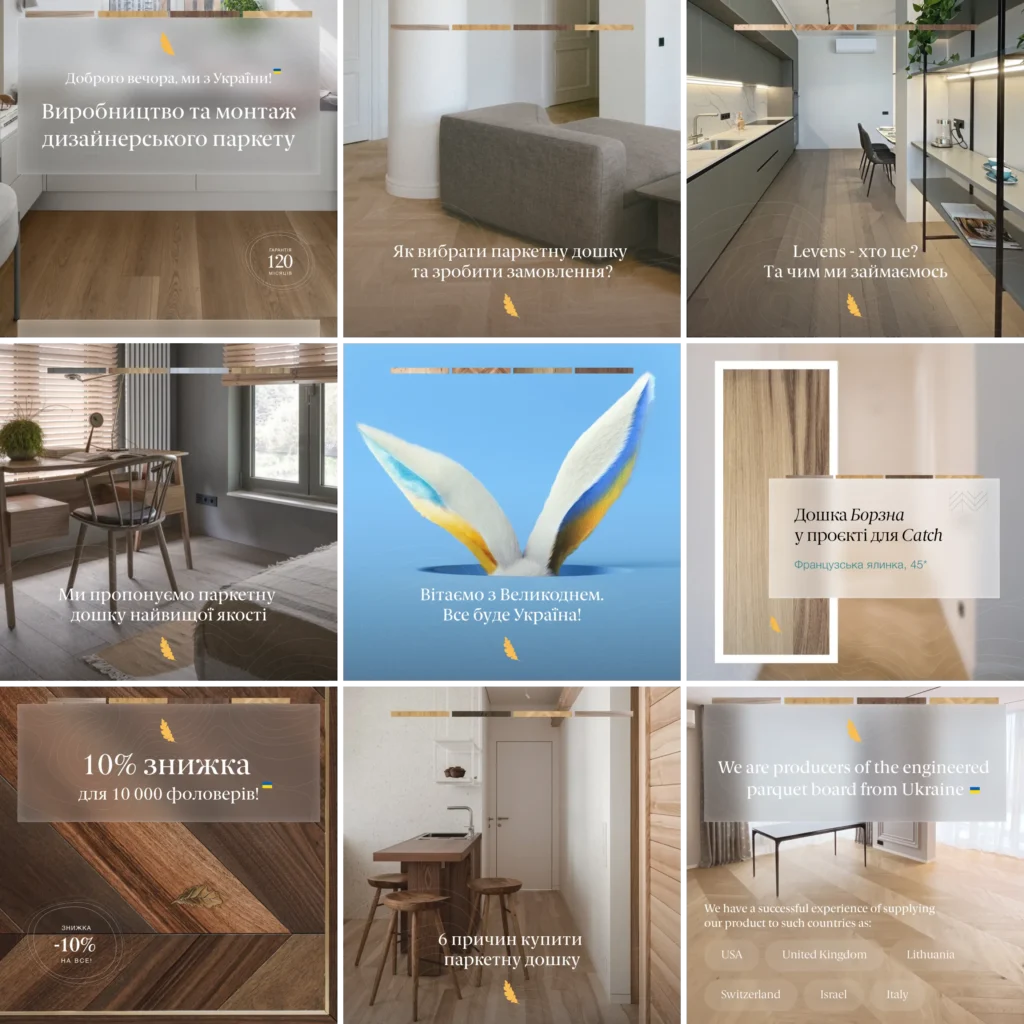
For Levens, a Ukrainian maker of designer oak and ash parquet, the wordmark is set in lowercase serif letters in deep teal, and a small gold oak leaf sits inside its v. That leaf then marks product cards, slides and social posts, and nine line icons are drawn in the same thin white line as the laying-pattern pictograms in the catalog. We carried the identity into the catalog website, nine Instagram posts and a company presentation with product sheets and prices.
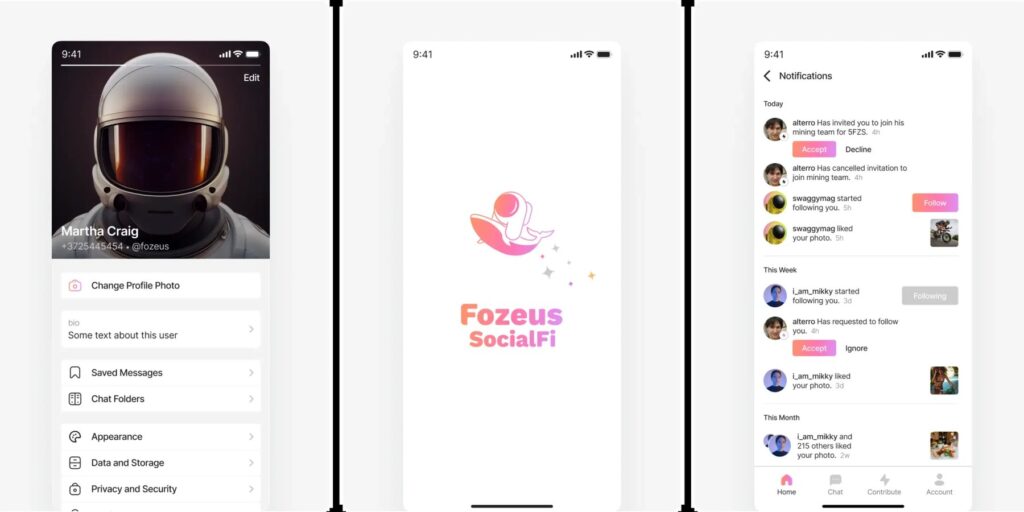
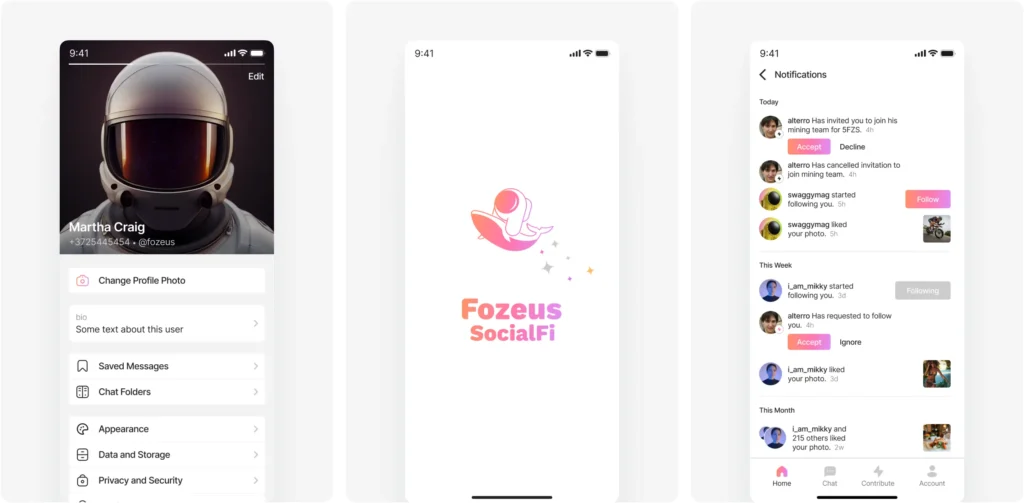
For Fozeus, a crypto social network where members mine the FZS token, we did a brand refresh together with the web and mobile app design. The coral-to-lilac gradient from its astronaut-on-a-whale logo marks only the key actions in the app, such as Start mining and Publish, and the astronaut became the base for a series of 3D NFT characters generated in the thousands.
Pitch decks are where brand and marketing material meet most directly. The Banxe deck uses the same kit as the product: white slides, wide headlines, hexagon outlines and app screens. More examples are in our pitch decks and presentations portfolio.
Branding or marketing: which do you need first?
It depends on where the company is. Here are four common situations and what each one calls for.
A startup before launch
Brand first
Positioning, name and identity, then the website and the deck.
A product that works and needs to grow
Marketing first
Channels and campaigns; check that the brand scales through templates.
A company planning a rebrand
Brand, then a launch plan
Change every touchpoint at once and tell existing customers.
Ads that convert poorly
Find where people drop off
Wrong audience: marketing. The right people leave: brand and landing page.
A startup before launch
Start with the brand foundations. Before you spend money on reaching people, decide what you are, who it is for and how you look and sound: positioning, name, logo, colours, typefaces and a short description you can repeat everywhere. Then apply them to the first things people will see, usually a website and, if you are raising money, a pitch deck.
Marketing at this stage is mostly research and small tests: talking to potential customers, a waitlist page, a few posts to see which message gets a response. Large paid campaigns can wait until you can say in one sentence what you do and for whom.
A product that works and needs to grow
Here marketing is the priority. You have customers and a product they use, so the task is to find more people like them: choose channels, run campaigns, measure the cost of each new customer and scale what pays off.
Check the brand for one thing: can it scale? If every new ad or landing page is designed from scratch, the team slows down and the look drifts. Brand guidelines and ready templates for posts, ads and presentations let a growing team produce more without losing consistency.
A company planning a rebrand
A rebrand is a branding project, and it is worth doing for branding reasons: the company has changed what it sells or who it sells to, it has merged with another business, or the old identity cannot stretch to cover new products. A rebrand will not fix weak targeting or a weak offer. We go through the steps in how to rebrand a company.
Marketing still has a job here. Plan how the change will be announced, update every touchpoint at once (site, app, social profiles, decks) so the old and new identities do not live side by side, and tell existing customers so they still recognise you.
A company whose ads convert poorly
First find out where people drop off. If the ads reach the wrong audience or the offer does not interest the right one, that is a marketing problem, and the targeting, the channel or the offer needs work.
If the right people click and then leave, look at the brand and the page they land on. Common signs: the page does not say in one line what the company does, the ad and the site look like two different companies, or the company looks like every competitor and gives no reason to trust it over them. In that case more ad spend only buys more of the same drop-off. Clearer messaging and a consistent identity fix the page the ads point to.
How thelegacy approaches brand identity work
thelegacy is a design studio, not a marketing agency. We do not run ad campaigns, buy media or manage channels. What we do is brand identity and the design side of marketing materials: websites, social media templates, presentations and pitch decks, drawn so they all look like one company. The examples above are from our own projects.
If you need a new brand identity, or want an existing one carried consistently into a website, a deck or social media templates, see our brand identity work or contact us about your project.
Key takeaways
- Branding defines who a company is, what it promises and how it looks and sounds, while marketing finds the people who need the product and persuades them to act.
- Branding works on a horizon of years and changes slowly, while marketing runs in campaigns of weeks or months with constant testing.
- Branding is judged by recognition, recall and consistency, while marketing is judged by leads, conversion rate, cost per customer and revenue.
- The two depend on each other: the brand gives marketing its positioning, voice and visual system, and marketing results show which brand messages customers respond to.
- A startup before launch should set its brand foundations first, while a product that already works and needs to grow should put marketing first.
- When the right people click on ads but leave without acting, the cause is often unclear messaging or an inconsistent identity, and more ad spend will not fix it.
- Advertising is the paid part of marketing; branding is the base under both and decides what every campaign looks like, sounds like and promises.
Frequently asked questions
What is the main difference between branding and marketing?
Branding defines who a company is, what it promises and how it looks and sounds. Marketing finds the people who need what the company sells and persuades them to act. Branding works over years, marketing in campaigns and short test cycles.
Is branding part of marketing?
In many companies the brand team sits inside marketing, so branding is treated as one of marketing's tools. In practice they work better as separate disciplines: branding decides who the company is and changes rarely, while marketing brings that company to buyers every day. They overlap in brand marketing, campaigns that build awareness rather than ask for a sale.
What is the difference between branding, marketing and advertising?
Advertising is the paid part of marketing: search and social ads, banners and sponsorships. Marketing also covers research, positioning, content, email, partnerships, events and measurement. Branding sits under both and decides what every campaign and every ad looks like, sounds like and promises.
Should a startup do branding or marketing first?
Branding foundations first: positioning, name, logo, colours, typefaces and a short description to repeat everywhere, applied to the website and, if you are raising money, the pitch deck. Before launch, marketing is mostly research and small tests, and large paid campaigns can wait.
Can marketing work without branding?
It can bring sales, but each campaign starts from zero. Ads, website and decks look like different companies, nothing builds recognition, and when people cannot tell you apart from competitors, price is the only argument left.
How is the success of branding and marketing measured?
Branding is measured by recognition and recall, consistency across touchpoints, how customers describe the company and direct and branded search traffic. Marketing is measured by leads, conversion rate, cost per customer, return on ad spend and revenue.
My ads convert poorly. Is it a branding or a marketing problem?
If the ads reach the wrong audience or the offer does not interest the right one, it is a marketing problem. If the right people click and then leave, check whether the landing page says in one line what you do and whether the ad and the site look like the same company.
Does thelegacy do marketing?
Only the design side. thelegacy is a design studio: we do brand identity and the design side of marketing, which our Search Engine Marketing service page describes as landing pages, ad creatives and promotional materials, plus websites, social media templates, presentations and pitch decks. We do not run ad campaigns, buy media or manage channels.