Pitch Deck Examples: 11 Crypto and Fintech Decks, Slide by Slide

Good pitch deck examples are decks whose structure fits the reader: an investor deck walks from problem to raise, a services deck proves what a firm can do, a product deck explains one offer. Below are 11 real crypto and fintech decks designed at thelegacy, with slide counts, structure and the design decision behind each.
Every deck here has its own case page with the slides, and the work itself is part of our pitch deck design service. Use them as references for structure and tone, not as templates to copy.
What makes pitch deck examples worth studying?
A useful example shows a full slide order, not a single pretty cover. You want to see where the problem sits, how the product is shown, how numbers are made readable and how the deck ends. The 11 decks below range from 9 to 32 slides, and the spread is mostly explained by who reads them.
- One frame repeated. The best decks fix a grid, a headline style and a label position, then change only the content.
- Real product on the slides. App screens or platform views instead of feature lists.
- Numbers drawn to be read. Tables, donuts and worked examples where a paragraph would hide the figure.
- A clear last slide. Funding, contacts or a one-page summary, never a bare “Thank you”.
Which 11 decks are in this list?
Six are pitch decks that present a company to investors, four present a firm, a fund or its services, and one explains a single financial product. The table gives the type, length and the slide to open first on each case page.
| Deck | Company | Type | Slides | Open first |
|---|---|---|---|---|
| AYA | Beauty salon booking apps | Pitch deck | 13 | Competitors, one-page summary |
| Banxe | Fiat and crypto financial platform | Pitch deck | 19 | Product lines as hexagon tiles |
| Battue | Location-based mobile game with NFT items | Investor deck | 13 | Business model, fundraising |
| dEquity | Real estate as NFTs with its own DEX | Investor deck | 11 | Competitive landscape table |
| Optix | On-chain options protocol with a GameFi layer | Pitch deck | 14 | Three products, tokenomics |
| Souq | Financial market for game economies | Pitch deck | 22 | Today and Tomorrow product slides |
| Arch | Crypto-backed loans for individuals | Product deck | 9 | Self-repaying loan example |
| Amdax | Digital asset house, Amsterdam | Services presentation | 11 | Four service pillars |
| Skynet Trading | Market maker for digital assets | Company presentation | 12 | Services and proof |
| Skynet Fund | Fund manager, ecosystem fund for Aleph Zero | Fund deck | 12 | Fund terms and strategy |
| ICODA | Crypto marketing agency | Agency deck | 32 | Service slides |
What do the strongest investor decks have in common?
They show the product as it really looks and keep one visual frame from cover to close. The design follows the product, so an investor who opens the app later recognises it.
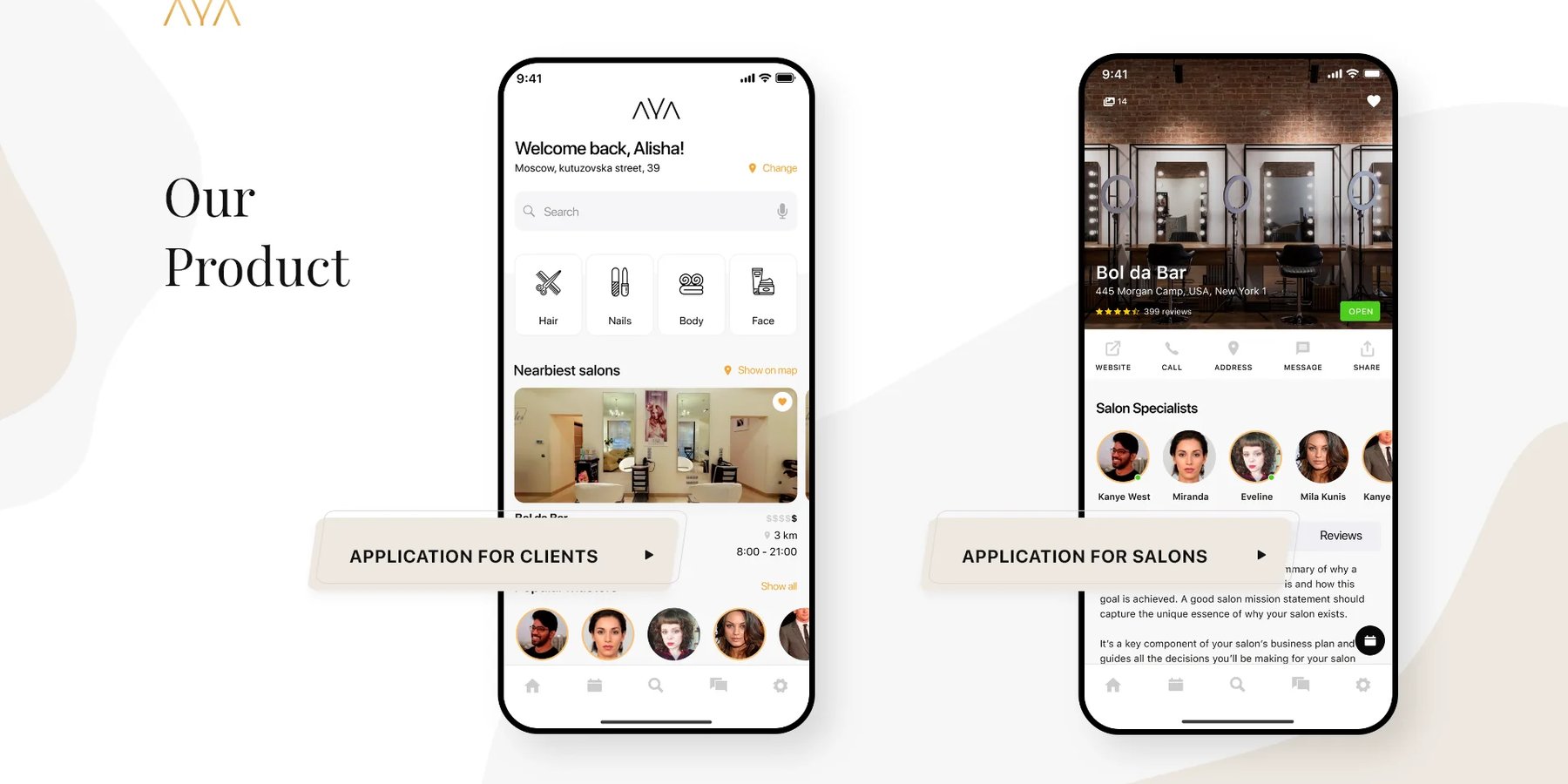
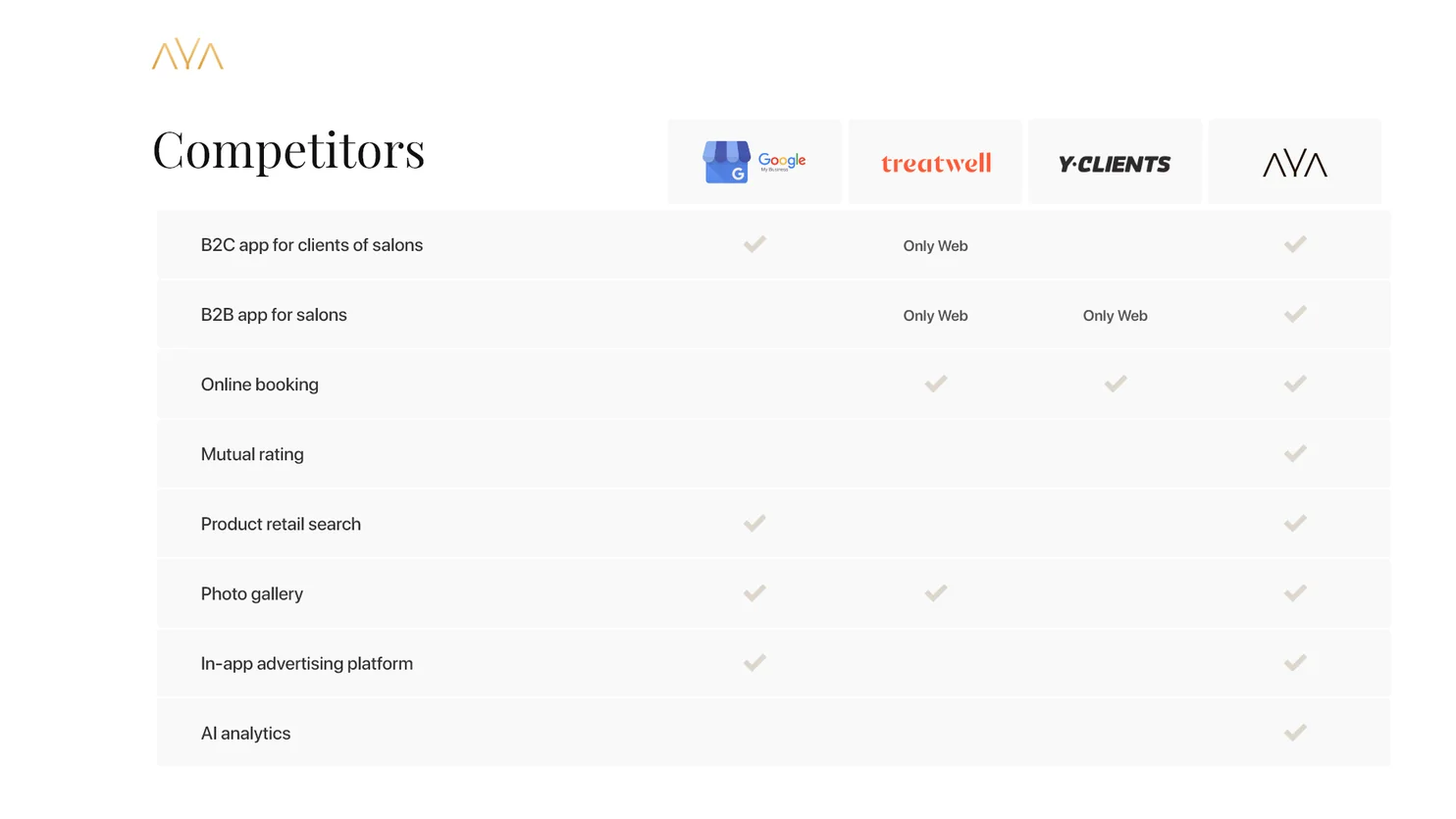
AYA is the clearest case. The thirteen slides use the language of the AYA apps, white with cream and gold and light serif headlines, and real app screens sit on the problem, product and summary slides. The competitor table lines up rival services in grey logo tiles with AYA’s column last, checked in every row, so the verdict reads before any text.
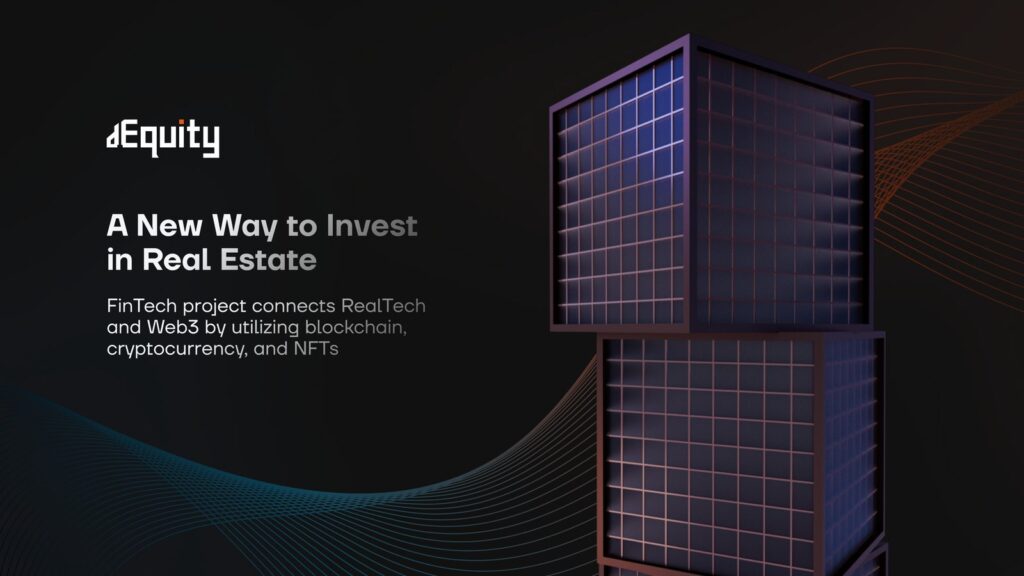
dEquity runs its eleven slides in the dark mode of its own platform. Headlines start white and fade to grey towards the end of the line, so the first words of each claim land first. On the competitive slide, dEquity is set against direct purchase, REITs and another tokenization platform across seven criteria, and tone carries the answer: grey where an option falls short, white where it delivers.
Souq, at twenty-two slides, is the longest investor deck here, and it earns the length with a fixed grid: monogram top left, lavender headline over a mint subhead, page number on a thin rule. Its product enters as a before and after, with a Today slide of current portfolio screens and a Tomorrow slide of one game page with yield and lending tiers.

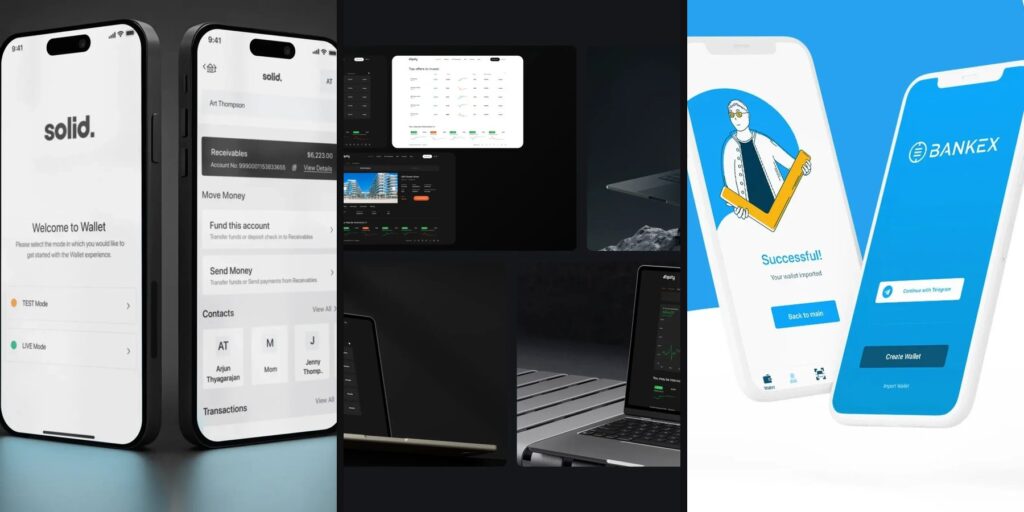
Banxe, Optix and Battue follow the same rule in their own colours. The Banxe deck is built from the kit of the Banxe app and brand, with lettered hexagon tiles for the product lines and the app in phones from cover to close. Optix keeps to the violet and yellow of its mark and uses the protocol’s 3D token renders, and Battue borrows the HUD frames, neon colours and monospaced type of the game’s website.
How is a company or services deck different?
It answers “can this firm do the job?” instead of “will this company grow?”. So it spends its slides on services, proof and people, and the order is shorter on market and longer on what the client gets.
Amdax sets out four service pillars one by one on alternating charcoal and white slides crossed by yellow diagonal bands, all cut at the same angle, so the stripes read as one pattern through the deck. Skynet Trading keeps the dark, star-lit look of its website and dashboard and moves from who the firm is to services, proof and contacts. ICODA needs thirty-two slides because it lists every service with what it includes.
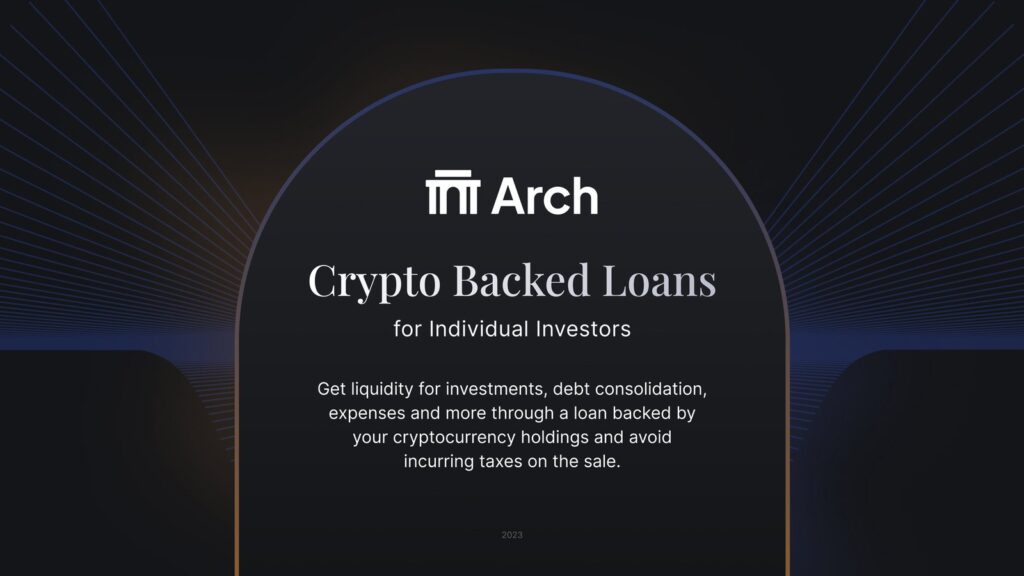
Arch is a product deck: nine slides for one crypto-backed loan. The cover sets the title inside a tall arch outlined in copper, taken from the columns of the Arch logo, and the self-repaying loan slide works its example as a small table, with the result in the only copper-filled cell.
What can you take from these best pitch deck designs for your own deck?
Take the structure for your deck type and one strong design decision, not the look. A checklist built from the 11 decks:
- Pick the deck type first: round, company presentation, fund or single product. It sets the length.
- Fix one frame (grid, headline style, labels, page numbers) before designing any slide.
- Put the real product on the slides, in its own colours and type.
- Turn every comparison into a table where the answer reads at a glance, as in AYA and dEquity.
- Show one worked example for any number that needs trust, as Arch does with its loan.
- End on an action: fundraising, contacts or a one-page summary.
If you are deciding whether to draft the deck yourself first, Can ChatGPT create a pitch deck? compares AI generators, templates and a designer. For a deck built on your product’s own visual language, see the pitch deck design service.
Key takeaways
- Deck length follows the reader: the investor decks in this list run 11 to 22 slides, while an agency deck that describes every service runs to 32.
- The strongest decks show the real product in its own colours and keep one frame from cover to close.
- A comparison works when the answer reads from the table without text, as in AYA and dEquity.
Frequently asked questions
What are some good pitch deck examples?
Decks that show the whole slide order and the real product. In this list that means, for example, AYA with its competitor table and one-page summary, dEquity in the dark mode of its own platform, and Souq with its Today and Tomorrow product slides.
How many slides should a pitch deck have?
It depends on the type. Among the 11 decks here, the product deck has 9 slides, the investor decks run from 11 to 22, and an agency deck that describes every service has 32.
What is the difference between a pitch deck and a company presentation?
An investor pitch deck explains why the company will grow and ends on the raise. A company or services presentation proves the firm can do the job, so it gives more room to services, proof and the team.
Can I use these decks as templates?
They were made for specific clients, so copying their look is a bad idea. Take the structure for your deck type and one design decision instead: one frame for the whole deck, real product screens, a comparison table.
Does a crypto pitch deck need a tokenomics slide?
If the product has a token, yes: dEquity, Optix and Souq each have tokenomics slides. Services decks such as Amdax or Skynet Trading do without one, because they sell a service, not a token.